
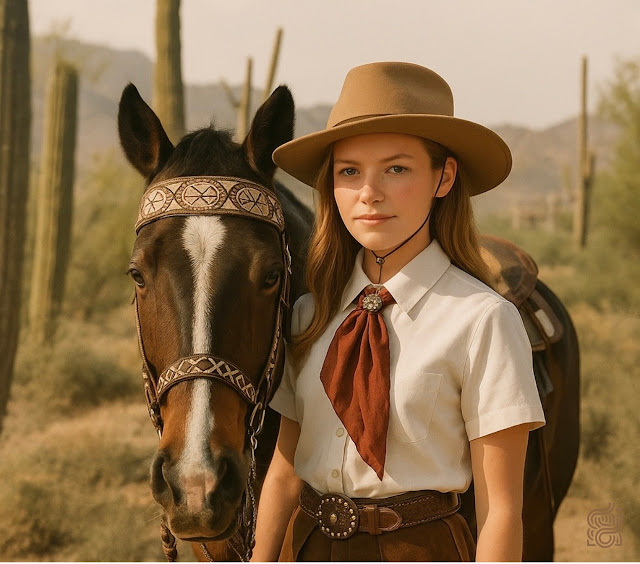

Image: A modern reinterpretation of the wool felt gambler hat traditionally worn in winter, a concho-style scarf slide, short-sleeved button-down shirt, and classic western belt buckle. A modern reinterpretation inspired by archival photographs.
Thinking about local clothing for the desert, I was inspired by historic photos of the uniforms worn by the ladies at the Hacienda del Sol Ranch School in the 1930s. I was curious to know what they wore in the summer heat in the desert and winter cold here. Digging in, I got some really interesting context to the times they were living in, and it gave me a greater appreciation for the ladies in the scene, and the details behind what they wore.

Image: 1930s. Students at the Hacienda del Sol ranch school in Tucson, Arizona. Scanned image from the text book “The Arizona Story” (2008) by the Arizona Historical Society, ISBN :1423625951, page 263. Originally created in the 1930s, scanned in 2015. The Old Pueblo, CC BY-SA 4.0, via Wikimedia Commons
The Dude Ranch Era
The 1930s marked the peak popularity of dude ranches, driven significantly by Hollywood’s romanticized western films, many of which were produced around Tucson. This era profoundly influenced women’s fashion, introducing iconic pieces like the first Lady Levi’s jeans in 1934 and the pearl-snap Western shirts popularized by Rockmount by 1940.
The cowboy spirit remains deeply embedded in Tucson’s culture, uniquely celebrated annually with a dedicated rodeo school holiday. Iconic dude ranches (also called guest ranches) like Tanque Verde Ranch and Hacienda del Sol maintain this vibrant legacy today.
Fashion as Freedom
In the 1930s “American society was still not fully comfortable with the idea of women wearing pants. Bifurcated garments seemed so unladylike.” Yet these very garments allowed women newfound physical freedom and self-expression. (Melissa Leventon, Riveted)
Adrienne Rose Bitar further describes:
“Vacationing was a secure laboratory—especially for women. When they looked in the mirror, they didn’t see their old self from Connecticut or Rhode Island. They saw a cowgirl from the movies. Denim afforded many women the ability to move more freely—to rethink their position in American society.” (PBS American Experience )
These practical clothes didn’t just facilitate movement—they transformed identities. Jeans offered young women of the era a form of freedom they maybe hadn’t had before.(PBS American Experience )
1930s Ranch School Uniform
The uniforms combined equestrian practicality with finishing-school refinement:
- Hats: Straw gambler hats for summer; wool felt gambler hats for winter. (Wikipedia: Frontier Gambler)
- Shirts: Short-sleeved, button-down utility shirts with neatly rolled cuffs.
- Trousers: High-rise, wide-legged trousers cropped just above the boots.
- Accessories: Bandanas cinched with concho slides, sturdy leather belts.

Image: Classic mid-calf western boots styled here with high-waisted cavalry twill trousers and a short-sleeved camp shirt, these mid-calf black cowboy boots have a modest 1.25″ stacked heel, round toe, and subtle Western stitching—true to 1930s riding style. A modern reinterpretation inspired by archival photographs.
Boot Styles of the Era
Boots were important, each style suited to different activities:
- Lace-Up Riding Boots: Tall, ankle-supportive boots ideal for riding.
- Paddock Boots: Shorter boots suitable for fieldwork and casual riding.
- Western Cowboy Boots: Mid-calf boots with modest heels and subtle embroidery.

Image: A modern reinterpretation inspired by archival photographs. An 1930s era equestrian lace-up riding boot style.

Image: A modern reinterpretation inspired by archival photographs. An 1930s era equestrian paddock boot style.

Image: A modern reinterpretation of the 1930s era gambler straw hat worn in summer, bandana, utility button-down shirt with short sleeves, trousers (pre-denim, so before 1933), basic belt buckle, and mid-calf cowboy boots with subtle embroidery and a low stacked heel, approximately 1.25 inches.
Mood boards & Style Studies
To visualize these garments more authentically, I created detailed mood boards exploring all kinds of inspiring details like:
- Embroidered boots, suede and leather textures, detailed stitching.
- Structured utility shirts, warm-toned wool gambler hats, bandanas and scarves.
- The leather accessories, metal conchos, and soft cotton fabrics.

Image: A mood board and study of vintage silhouettes and modern details they inspire—from equestrian saddles to beadwork to suede boots inspired by the 1930s girls’ ranch school in Arizona.

Image: A mood board of details. Denim jeans vs the pre-denim riding styles such as split riding skirts, high-waist jodhpers riding trousers. Equestrian layers such as batwing chaps, apron chaps, riding gloves, cowgirl riding boots, equestrian lace up riding boots, and totally new modern looks reinterpreting the materials and silhouettes. Warm tones and textured fabrics, detailing of Western girls’ ranch wear from the 1930s.

Image: A mood board of details. The styles of the past—some nostalgic, some timeless—and reinterpretations styled for now: wide-brimmed hats, utilitarian shirting, and structured pants grounded in equestrian heritage.
Each mood board was a personal visual study to connect the past to present. For me, the studies highlight the enduring utility and appeal of the desert Southwest, and western ranch wear.
Modern Interpretations
Based on studying the details, I’ve been able to pick a few things that are similar – to be able to recreate the style, reinvent it, honor it, or just bring it forward in time and appreciate it.
Here’s a few modern interpretations inspired by the original 1930s desert Southwest ranch school attire:
Western Cowboy Boots:
- Ariat Women’s Heritage J Toe Stretchfit Western Boots
- Classic Western-style Boot
- Gaucho Embroidered Snip-Toe Mid Calf Low Heel Cowgirl Boots
- Dover Saddlery Paddock Boot
Lace-Up Riding Boots:
- Lace-up Boot
- Mid Calf Work Boots
- Women Ladies Victory Leather English Field Boots Horse Back Riding Equestrian Tan
Paddock Boots:
Hats:
- Women’s Paper Braid Gambler Crown Hat (Summer)
- Stetson Gambler Straw Cowboy Wheat Hat (Summer)
- Gambler Crown Braided Chincord Hat (Winter)
- Silver Canyon Women’s Gambler Telescope (Winter)
- Jeanne Simmons Women’s Gambler Crown Large Brim Leatherette Band Hat (Winter)
Shirts:
- Cotton Short Sleeve Button Down
- Short Sleeve Button Down Shirts Summer Cotton Plain Top Blouses with Pockets
- Wrangler Authentics Short Sleeve Classic Woven Shirt
- Women’s Flowy Wide Leg Pants – Chocolate
- Tronjori Women Casual Palazzo Pants
- Lee Women’s Ultra Lux Comfort Wide Leg Utility Crop Capri Pant
- High Waisted Cropped Wide Leg Stretchy Straight Pants Trousers with Pockets
- Ralph Lauren Women’s Pleated Cotton Twill Cropped Pants
Accessories:
- Cotton Paisley Bandana
- Western Concho Scarf Slide
- Brown Leather Belt with Square Buckle
- Cowboy Paisley Wild Rag
- Mulberry Silk Scarf Neckerchief Headscarf

Image: Inspired by the 1930s ranch school, this look reimagines a Hacienda del Sol Ranch School for girls uniform: straw gambler hat, rolled-sleeve button-down utility shirt, high-rise trousers, leather belt, and a bandana scarf cinched with a concho slide—blending Southwestern equestrian utility with finishing school polish.

Image: This look reimagines a Hacienda del Sol Ranch School uniform: straw Stetson cowboy style hat, button-down utility shirt, high-rise wide-leg trousers, leather belt, and a rust bandana scarf cinched with a concho slide, and lace up riding boots—blending Southwestern equestrian utility with finishing school polish.
Sources & Historical Inspiration
This exploration draws from:
- The Arizona Story, Arizona Historical Society (2008)
- “Reading, Writing and… Ranching” – Arizona Highways
- PBS American Experience: “Riveted: The History of Jeans”
- Wikipedia – Hacienda del Sol
Every element of the uniforms was purposeful, and practical — from the hats to the boots.
More to Discover
There’s a lot more history and details to discover. I’ll explore more in future posts.
This post includes affiliate links. All opinions are my own. Visuals created using AI and non-AI tools, guided for historical accuracy. Styling, research, and curation by me, exploring the history and visual details of the era.


Leave a Reply