

https://youtube.com/shorts/hPiCi00sx0w
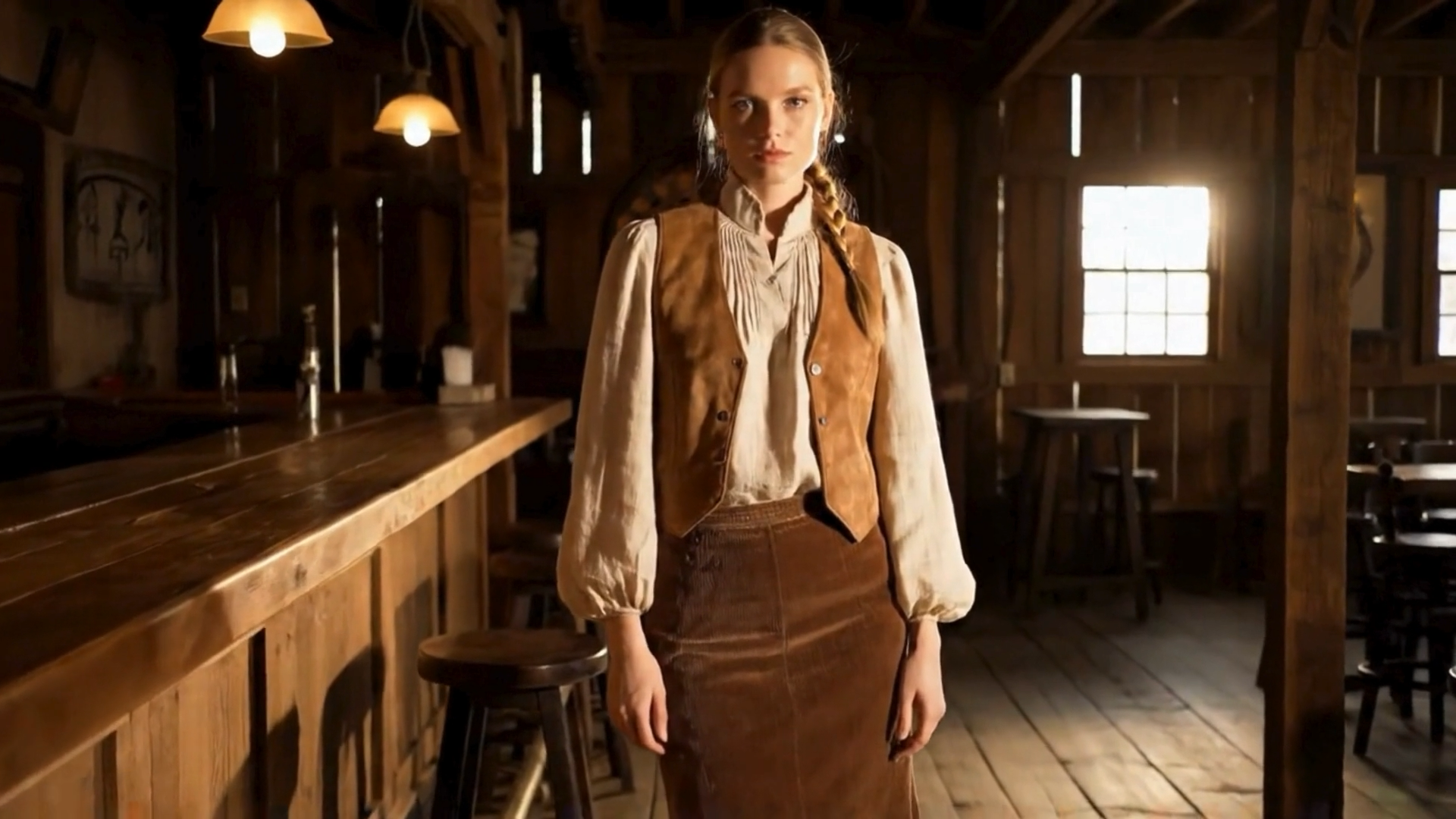
This modern interpretation of 1870s Southwestern frontier fashion represents a carefully balanced fusion of historical accuracy and contemporary wearability. Understanding the educational context behind each element reveals the rich textile heritage of Arizona’s territorial period and demonstrates how regional influences shaped frontier fashion.
Bishop Sleeves: From Medieval Vestments to Victorian Elegance
Historical Origins and Evolution
The bishop sleeve traces its lineage back to medieval religious vestments, where it first appeared on ecclesiastical robes worn by bishops and clergymen1. The loose, flowing design allowed ease of movement while maintaining an air of ecclesiastical dignity. The name itself derives from this resemblance to the voluminous sleeves found on traditional bishop’s garments2.
Victorian Popularization (1830s-1890s)
During the Victorian era, bishop sleeves became a prominent feature in women’s fashion, reaching their height of popularity between the 1830s and 1890s13. They were characterized by their fullness and gathered cuff, creating an ethereal quality that captured the imagination of fashion enthusiasts. The sleeves were often constructed from delicate fabrics such as lace or sheer materials, emphasizing femininity and sophistication2.
The 1870s saw a particular appreciation for these sleeves, as they aligned with the era’s preference for complex, voluminous garments. During this decade, sleeves were often designed to reflect the wearer’s social status, and bishop sleeves symbolized elegance and refinement2. Victorian pattern publications like Godey’s Lady’s Book helped disseminate these styles across the American frontier, ensuring that even women in remote territories like Arizona could access current fashion trends456.
Construction Details
Authentic Victorian bishop sleeves required specific construction techniques. The fullness was typically controlled through gathering or pleating at the shoulder and cuff7. The sleeve was usually cut as a rectangle that gradually tapered toward the wrist, with the gathered cuff creating the distinctive silhouette. In the 1870s, these sleeves were often made from the same fabric as the dress bodice, though contrasting fabrics were occasionally used for visual interest.
Modern Interpretation
The contemporary version in your outfit captures the essential visual elements while adapting to modern construction methods. The lightweight linen fabric provides the flowing movement characteristic of historical bishop sleeves while being practical for desert climates—a consideration that would have been just as important to 1870s Arizona women dealing with similar environmental challenges.
Suede Waistcoat: The Frontier Necessity Turned Fashion
Historical Context of Waistcoats
The waistcoat, or vest as it became known in American terminology by the 1890s, had deep roots in menswear dating back to the 1660s8. By the 1870s, waistcoats had become essential elements of both men’s and women’s wardrobes, serving both functional and aesthetic purposes.
Materials and Regional Adaptations
In the middle of the 19th century, waistcoats were often colorful and made from a variety of fabrics, including checked and striped materials, delicate woven patterns, and importantly for frontier regions, leather and suede9. The choice of suede for frontier wear was particularly practical—it was durable, provided warmth during cool desert evenings, and was often locally available through trade networks with Native American communities and Mexican leather workers.
Frontier Functionality
Pioneer women found waistcoats invaluable for their utility. They provided extra pockets for carrying essential items, offered an additional layer of warmth during temperature fluctuations common in desert climates, and created a polished appearance even when worn over simple work dresses410. The waistcoat allowed frontier women to maintain a sense of fashion-consciousness while adapting to practical necessities.
Construction Techniques
Period waistcoats featured several distinctive construction elements: they were typically single-breasted with a line of buttons down the front, had a back panel in a different fabric (often cotton or linen for comfort), and included adjustment mechanisms at the back waist9. The front panels were carefully shaped to create a fitted silhouette that complemented the era’s preference for defined waistlines.
Cultural Significance in Arizona Territory
In the Arizona Territory during the 1870s, the blending of Anglo-American, Mexican, and Native American influences created unique regional variations in dress. Suede waistcoats represented this cultural fusion—combining European garment construction with materials and techniques familiar to indigenous and Mexican artisans who had long worked with leather1112.
Mermaid Skirt: The Controversial Silhouette
The “Scandalous” 1890s Innovation
Here is an image depicting a late 19th-century fashion silhouette, showcasing the “puffed flank” or “tail-like” effect with a structured corset that was an early precursor to the mermaid silhouette:

Late Victorian and Edwardian Mermaid Skirt
Here is an image of a skirt that blends late Victorian and Edwardian styles with a fitted and flaring silhouette:


The mermaid or trumpet skirt emerged in the 1890s as part of the late Victorian fashion evolution. This silhouette was considered revolutionary—and often scandalous—because of how closely it followed the natural lines of the female form13. The style was characterized by a fitted silhouette through the hips that flared dramatically at the knee or lower, creating a shape that “caused a scandal” among conservative Victorian society13.
Construction and Technical Details
Creating an authentic mermaid skirt required sophisticated construction techniques. The pattern was based on original 1890s designs and required careful attention to seaming and shaping1314. The skirt was typically made from substantial fabrics that could hold the dramatic shape—wool, heavy cotton twill, and notably, corduroy were all appropriate period choices13.
Corduroy: The Practical Choice
Corduroy’s selection for this piece reflects both historical accuracy and practical adaptation to frontier life. This ribbed cotton fabric was durable, washable, and provided the structure necessary for the mermaid silhouette while being suitable for the active lifestyle required of frontier women15. The fabric’s texture also added visual interest that complemented the smooth suede of the waistcoat.
Regional Variations
In the American Southwest, including the Arizona Territory, the mermaid skirt would have been adapted to local conditions. The tight fit through the hips would have required careful consideration of undergarments—frontier women often wore fewer petticoats than their Eastern counterparts due to the heat, making the close-fitting silhouette more practical in desert climates1610.
Arizona Territorial Context (1870s)
Cultural Melting Pot
The 1870s were a transformative period for Arizona Territory. Following the Civil War, the region experienced an influx of Anglo-American settlers, while maintaining its existing Mexican and Native American populations1711. This cultural convergence created unique opportunities for fashion fusion, where European-American styles merged with regional materials and techniques.
Climate Considerations
The harsh Sonoran Desert environment significantly influenced clothing choices. Women in territorial Arizona had to balance fashion aspirations with practical necessities1618. The combination of extreme heat during the day and cooler temperatures at night required adaptable layering systems—exactly what the bishop sleeve blouse and suede waistcoat combination provided.
Economic and Social Factors
Despite its frontier status, Arizona Territory was not a cultural backwater. Towns like Tucson maintained active merchant communities with connections to both Mexican suppliers and American commercial networks11. Fashion information traveled through publications like Godey’s Lady’s Book, and traveling merchants brought both materials and finished goods from Eastern markets45.
Fabric Access and Trade Networks
The territory’s position as a crossroads between Mexico and the United States created unique access to materials. Cotton had been grown in the region for centuries by Native American communities1920, while trade relationships with Mexico provided access to high-quality textiles and leather goods11. This combination of local production and trade networks enabled relatively sophisticated fashion choices even in frontier settings.
Modern Adaptations and Historical Accuracy
What’s Historically Authentic:
- Bishop sleeve construction: The gathered cuff and voluminous shape accurately reflect 1870s patterns
- Waistcoat styling: Single-breasted closure and fitted silhouette match period examples
- Mermaid skirt concept: While slightly early for the 1870s, the fitted-through-hips silhouette reflects emerging trends
- Material choices: Linen, suede, and corduroy were all available and appropriate for the period
- Color palette: Earth tones and desert hues reflect both practical considerations and regional preferences
What would be Modified for Modern Wear:
- Fit and proportion: Modern sizing and fit standards applied to historical silhouettes
- Construction techniques: Contemporary sewing methods and notions used while maintaining period appearance
- Fabric weights: Modern textile production creates different hand and drape than period equivalents
Educational Significance
This outfit is an example of how fashion history intersects with social, economic, and cultural history. Each element tells part of the story of Arizona’s territorial period:
- The bishop sleeves demonstrate how European fashion trends adapted to frontier practicality
- The suede waistcoat represents the blending of Anglo-American, Mexican, and Native American material cultures
- The overall combination illuminates the fashion consciousness that existed even in remote territorial communities
Understanding these historical contexts enhances appreciation for both the original garments and their modern interpretations, revealing the rich cultural tapestry that shaped fashion in the American Southwest. The spirit of cultural fusion and adaptation that characterized 1870s Arizona Territory lives on in contemporary fashion interpretations that honor both historical accuracy and modern wearability.
Sources and Further Reading
This analysis draws from contemporary fashion publications, museum collections, archaeological evidence, and scholarly research on frontier fashion, territorial Arizona history, and Victorian clothing construction techniques. The interconnected nature of fashion, culture, and geography becomes particularly evident when examining regional variations in historical dress, making the Arizona Territory an especially rich case study for understanding how environment and cultural exchange shaped fashion choices in the American Southwest.
- https://thelist.app/explore/page/bishop-sleeve
- https://fazbuy.com/blogs/fashion-terms/what-is-bishop-sleeves-fashion-terms-explained
- https://canvasandcharms.com/blogs/history-of-fashion/a-stitch-in-time-unraveling-the-story-behind-bishop-sleeves
- https://www.jobcarrmuseum.org/blog/women-s-work-creating-clothing-on-the-frontier
- https://www.uvm.edu/~hag/godey/fashion/index.html
- https://web.colby.edu/bookhistory2020/2018/04/23/trend-setting-for-the-women-of-its-time-an-exploration-into-godeys-ladeys-fashion-plates/
- https://genealogylady.net/2015/07/26/fashion-moments-bishop-sleeve/
- https://en.wikipedia.org/wiki/Waistcoat
- https://collections.vam.ac.uk/item/O78915/waistcoat-unknown/
- https://recollections.biz/blog/pioneer-clothing-what-women-wore-in-the-western-frontier/
- https://publishing.cdlib.org/ucpressebooks/view?docId=ft0f59n6xw%3Bchunk.id%3Dd0e3039%3Bdoc.view%3Dprint
- https://publishing.cdlib.org/ucpressebooks/view?anchor.id=0&brand=eschol&chunk.id=d0e419&doc.view=content&docId=ft0f59n6xw&toc.depth=1
- https://reconstructinghistory.com/products/rh948-late-victorian-and-edwardian-mermaid-skirt
- https://reconstructinghistory.com/products/rh946-late-victorian-1870s-1890s-skirt-for-all
- https://en.wikipedia.org/wiki/Victorian_fashion
- https://www.arizonahighways.com/archive/issues/chapter/Doc.929.Chapter.7
- https://arizonahistoricalsociety.org/education/esperanza/early-tucson/
- https://www.desertusa.com/desert-people/pioneer-woman.html
- https://www.arizonahighways.com/archive/issues/chapter/Doc.412.Chapter.2
- https://www.inmaricopa.com/cotton-woven-in-pinal-county-along-gila-river-since-ancient-peoples/
- https://www.academia.edu/28792077/Tucsons_Squaw_Dress_Industry
- https://www.tucsonmuseumofart.org/press/desert-dweller/
- https://statelibraryofarizona.wordpress.com/2023/08/
- https://historicalsewing.com/sleeve-shifts-of-the-1890s
- https://www.longislandpress.com/2019/07/05/frontier-fashion/
- https://statefortyeight.com/blogs/blog/an-arizona-clothes-store-history-of-arizona-clothes
- https://thelist.app/explore/page/bishop-sleeve?srsltid=AfmBOooa5xETlmFrPKOwy9bb9KPbZ7csuY7zHCfZJuqcZovMm8WfjraA
- http://houstonculture.org/vc/azmextime.html
- https://recollections.biz/clothing/OldWestSkirts.html
- https://capla.arizona.edu/sites/default/files/VAF%20Field%20Guide%20Final%20r.pdf
- https://canvasandcharms.com/blogs/history-of-fashion/a-stitch-in-time-unraveling-the-story-behind-bishop-sleeves?srsltid=AfmBOoq-rKym-A2ivyPd0blLjxHAKaTwdJTyc1V9Y28GPqcH-qdbUEMx
- https://recollections.biz/blog/pioneer-clothing-accessories-women-wore-on-the-frontier/
- https://en.wikipedia.org/wiki/1870s_in_Western_fashion
- https://www.gentlemansgazette.com/men-stop-wearing-waistcoats/
- https://capla.arizona.edu/sites/default/files/Guide%20to%20Tucson%20Historic%20Neighborhoods-Final.pdf
- https://www.historicalemporium.com/search/?q=+1870s+Mens+Vests&page=2
- https://www.garmentory.com/sale/all/skirts/445789-corduroy-mermaid-skirt
- https://www.youtube.com/watch?v=bsAln7n82zE
- https://victorianweb.org/victorian/art/costume/nunn8.html
- https://honolulumuseum.org/pQ3D3Uv/homa-selects—waistcoat
- https://www.tucsonrealtors.org/wp-content/uploads/National-Register-Historic-DistrictsPDF.pdf
- https://www.etsy.com/listing/897645035/corduroy-pinafore-dress-skirt-overall
- https://www.etsy.com/market/old_west_waistcoat
- https://www.pinterest.com/pin/492649952203478/
- https://archives.sharlothallmuseum.org/articles/days-past-articles/1/prescott-style-through-the-ages
- https://en.wikipedia.org/wiki/Mother_Hubbard_dress
- https://www.goodreads.com/book/show/410634.Fashions_and_Costumes_from_Godey_s_Lady_s_Book
- https://www.marnajeandavis.com/blog/mother-hubbard-dresses-not-prairie-dresses
- https://heritagesquarephx.org/wp-content/uploads/2017/03/Dressing-Downton-Docent-Training-1.pdf
- https://www.journals.uchicago.edu/doi/10.1086/676031
- https://books.google.com/books/about/Fashions_and_Costumes_from_Godey_s_Lady.html?id=IQweAwAAQBAJ
- https://thesquarephx.org/wp-content/uploads/2017/03/Dressing-Downton-Docent-Training-1.pdf
- https://monmouthhistory.emuseum.com/objects/3075/dress;jsessionid=3E719ECDA6FB862A9013BD9BB80C8FCE
- https://upload.wikimedia.org/wikipedia/commons/8/84/Godey’s_Lady’s_Book_Vol._XIII.pdf
- https://sites.udel.edu/rockwoodarchives/exhibit/fashion/
- https://recollections.biz/clothing/CalicoOutfits.html?CatListingOffset=48
- https://prairietimes.com/godeys-ladys-book/
- https://lernerbooks.com/excerpts/22753.pdf?srsltid=AfmBOopWspTTqqnMAywN4gWzw1XKVSFBkDkEuCqgRwCnYMuaa3U-t8z2
- http://cas.loyno.edu/sites/cas.loyno.edu/files/Godey’s%20Lady’s%20Book%20and%20Sarah%20Josepha%20Hale_Making%20Female%20Education%20Fashionable.pdf
- https://www.encyclopedia.com/fashion/encyclopedias-almanacs-transcripts-and-maps/america-central-and-mexico-history-dress
- https://epmuseumofhistory.org/exhibitions/past/exhibit/40
- https://statemuseum.arizona.edu/sites/default/files/Wrapped%20in%20Color%20Exhibit%20Booklet%202.pdf
- https://indearizona.com/the-squaw-dress-tucsons-controversial-but-unique-fashion-history/
- https://fashionhistory.fitnyc.edu/1870-1879/
- https://www.encyclopedia.com/fashion/encyclopedias-almanacs-transcripts-and-maps/america-south-history-dress
- https://silhouettescostumes.com/the-eras-we-build/1840-1914-american-west/
- https://www.cuttersguide.com/pdf/References/the_nineteenth_century_(history_of_costume_and_fashion_volume_7).pdf
- https://www.tempe.gov/government/community-services/tempe-history-museum/history-and-research/hispanic-history
- https://www.elpasotexas.gov/assets/Press-Releases/2023.06.27-NEWS-RELEASE_El-Paso-Museum-of-History-Presents-Desert-Couture-Fashioning-Two-Centuries-in-the-Southwest.pdf
- https://www.phoenix.gov/content/dam/phoenix/pddsite/documents/hp/pdd_hp_pdf_00044.pdf
- https://sunnyslopehistoricalsociety.org/jewels-of-the-desert/
- https://repository.arizona.edu/bitstream/handle/10150/553962/AZU_TD_BOX237_E9791_1961_30.pdf?sequence=1&isAllowed=y
- https://ia801209.us.archive.org/35/items/dressmaker00butt/dressmaker00butt.pdf
- https://azdot.gov/sites/default/files/2023-03/alex-kerr-essay.pdf
- https://victorianweb.org/art/costume/nunn12.html
- https://scholars.unh.edu/bowen_collection/703/
- https://www.academia.edu/1042247/Cut_Stitch_and_Fabrics_Female_Dress_in_the_Past_200_Years
- https://www.historicalemporium.com/top-ten-victorian-gloves
- https://historicalsewing.com/demystifying-victorian-bodice-construction
- https://fabricsthatgo.com/authentic-southwest-fabric-tucson-arizona-upholstery-drapery/
- https://www.harvard.com/book/9781847886828
- https://www.moodfabrics.com/arizona-turquoise-orange-and-red-striped-cotton-twill-434302
- https://www.aboutbritain.com/articles/victorian-fashion-accessories.asp
- https://teainateacup.wordpress.com/2015/05/06/making-an-early-1870s-gown-skirts/
- https://www.etoffe.com/en/furnishing-fabrics/24090-arizona-fabric-casamance.html
- https://vintagedancer.com/victorian/ladies-victorian-gloves/
- https://historicalsewing.com/constructing-victorian-bustle-dress
From Fishtail to Trumpet: Tracing the Birth of the “Mermaid” Skirt Silhouette
The fitted-through-the-hip, flared-at-the-hem skirt that modern fashion calls the mermaid or trumpet silhouette did not arrive fully formed in a single year. Rather, it evolved in three overlapping phases—late-1870s “fishtail” experimentation, gradual refinement through the 1880s–90s, and wide recognition as the “trumpet skirt” between 1898 and 1901. By the closing years of the 1890s, women’s journals and pattern houses were already offering multi-gored skirts that hugged the thigh and blossomed below the knee, laying the groundwork for the named “trumpet skirt” of the Edwardian decade.
Defining the Silhouette
- Mermaid / Trumpet Skirt: A skirt or dress cut tightly over waist, hip, and upper thigh, then dramatically flaring outward—often beginning around the knee—to create a bell or tail effect12.
- Fishtail / Princess Line Precursors: Late-Victorian gowns with a long, narrow train descending from a fitted bodice, visually similar to a fish’s tail34.
1877–1889: The First Fishtail Experiments
The earliest documented garments with a recognisably “fish-tail” line appeared in Charles Worth’s late-1870s evening gowns and in fashion‐plate commentary of 1877, when Le Bon Ton and other magazines praised skirts that narrowed to the calf before spilling into a train4. These styles depended on cuirasse (armour-like) corsets that extended over hip and thigh, forcing women to take small steps and accentuating the taper3. While visually arresting, the design remained an elite evening novelty and never gained the everyday popularity of later trumpet skirts.
1890–1896: Gores, Gigot Sleeves, and a Bell-like Skirt
Through most of the 1890s, women’s daywear featured enormous leg-of-mutton sleeves balanced by a bell-shaped, five-to-seven-gored skirt that fell smoothly from waist to hem52. The waist was cinched, but fullness began immediately below the hip, producing more of an A-line than a trumpet shape. Pattern literature from The Delineator in 1895 still described fashionable skirts as “broad flare” at the front with fullness introduced high on the hip—distinct from the lower-knee flare that defines trumpet silhouettes6.
Key Construction Innovations
- Multiple gores: dividing the skirt into narrow bias-cut panels allowed a snugger fit over the upper leg without adding bulk at the waist67.
- Foundation skirts: separate inner skirts provided support while allowing the outer layer to flow, encouraging experimentation with slimmer lines8.
1897–1899: The Late-Decade Shift Toward Trumpet Lines
Around 1897, the introduction of the straight-front (S-bend) corset pushed the torso forward and hips back, visually slimming the thigh and encouraging narrower skirts5. By 1898 designers began lowering the point of flare:
- Historical photographs show skirts “fitting more closely over the hip and flaring just above the knee” in 1898–99 streetwear1.
- Retail patterns such as Butterick’s “Consuelo” seven-gore model (May 1896) were marketed specifically for their deep rolling folds held low on the leg, anticipating trumpet contours9.
- Pattern-making manuals of 1899 recommended adding extra width “6in below the knee” to achieve the new fluted hem10.
1900–1901: The Trumpet Skirt Names Itself
By 1901, fashion chroniclers treated the “Trumpet Skirt” as a distinct, must-have garment:
| Year | Primary Term Used in Fashion Press | Core Features Described | Sample Source |
|---|---|---|---|
| 1898 | “Slim seven-gored walking skirt” | Fits over hip, flare begins mid-thigh | Consuelo skirt pattern9 |
| 1899 | “Fluted hem skirt” | Extra gores spread below knee | Delineator instructions6 |
| 1901 | “Trumpet Skirt” | Narrow through thigh, wide hem, 5–7 gores | Truly Victorian timeline11 |
The same 1901 timeline notes that the trumpet skirt immediately became “the shaping base” for the early Edwardian silhouette, confirming that the term—and a mature version of the form—was fully mainstream by that year11.
Conclusion: Did It Emerge in the 1890s?
- Prototype fishtail gowns date to 1877, establishing the basic concept34.
- Technical groundwork—multiple gores, hip-hugging cuts—was refined through the mid-1890s26.
- Wide-scale adoption of a lower flare and the trumpet name crystallised between 1898 and 1901111.
Therefore, while the idea of a mermaid-like skirt predates the 1890s, the trumpet silhouette recognizable to modern eyes did indeed emerge in the very late 1890s and was universally acknowledged by 1901.
- https://rarehistoricalphotos.com/female-fashion-1890s/
- https://www.apparelsearch.com/definitions/fashion/1890_fashion_history.htm
- https://yolancris.com/mermaid-dress-history-and-inspiration/
- https://www.newyorkdress.com/blogs/fashion-blog/what-is-a-mermaid-dress
- https://fashionhistory.fitnyc.edu/1890-1899/
- https://historicalsewing.com/1895-nine-gored-skirt-delineator-no-7856
- https://neheleniapatterns.com/produkt/1890s-5-gore-skirt-lm101/?lang=en
- https://www.allentownartmuseum.org/exhibitions/past/the-beautiful-bodice-fashions-from-the-1890s/
- https://pastpatterns.com/pattern/mid-1890s-seven-gored-skirt-sewing-pattern/
- https://oralinpatterns.com/products/1900s-trumpet-skirt-pdf-sewing-pattern
- https://trulyvictorian.info/index.php/extras/timeline-of-victorian-clothing/edwardian-1900-1917/
- https://www.artchive.com/artwork/sketch-for-a-mermaid-john-william-waterhouse-1892/
- https://www.mellominds.com/the-history-of-mermaid-dresses/
- https://www.youtube.com/watch?v=jAFgMM8xADw
- https://www.royalacademy.org.uk/art-artists/work-of-art/a-mermaid
- https://www.youtube.com/watch?v=pWp1weXC7wM
- https://www.alamy.com/stock-photo/mermaid-painting-19th-century.html
- https://www.fumiabridal.com/blog-posts/the-history-and-evolution-of-the-mermaid-gown
- https://www.mediastorehouse.com/galleries/mermaid
- https://www.metmuseum.org/art/collection/search/159443
Corduroy in the Old West?
Corduroy, originating from “fustian” in ancient Egypt, became popular in Europe in the 18th century. During the Industrial Revolution, it transitioned from a luxurious fabric to a durable and affordable material for the working class. This increase in production and affordability facilitated its wider distribution, including the western United States where textiles were often imported from the East and West coasts.
While denim was rapidly gaining popularity as the preferred workwear in the 1870s, particularly due to the commercialization of riveted reinforcement in pants, corduroy was still a common and accessible fabric. It was used for garments like trousers, jackets, and shirts by cowboys and other residents of the Old West, making its presence in the Desert Southwest probable in 1870. Stores in towns like Tucson would have sold a variety of fabrics and finished clothing, and records indicate the presence of dry goods stores in the area during this period.
1. On American Corduroy’s Versatility and Legacy (AVANT Magazine):
- Source: “American Corduroy: An Unsung Hero of Versatility.” AVANT, November 5, 2024.
- Access: https://www.theavantmag.com/stories/american-corduroy
2. On Corduroy’s European Popularity and Name Origin (Encyclopedia.com):
- Source: “Corduroy.” Encyclopedia.com, August 13, 2018.
- Access: Encyclopedia.com
3. On Corduroy’s Ancient Roots (Recollections Blog):
- Source: “The history of corduroy.” Recollections Blog, October 20, 2022.
- Access: Recollections
4. On Corduroy’s Use During the Industrial Revolution (Pope & Bradley):
- Source: “Corduroy’s Tough Journey – From Manchester to Matera.” Pope & Bradley.
- Access: Pope & Bradley
5. On Corduroy’s Rich History (Canoe Club):
- Source: “The Rich, Velvety History of Corduroy.” Canoe Club, November 19, 2020.
- Access: Canoe Club
6. On Tucson Business Records (Ayres Index – Arizona Historical Society):
- Source: “Ayres Index – Tucson Business.” Arizona Historical Society, May 1, 2019.
- Access: Arizona Historical Society
7. On Tucson Retail Stores along Congress Street (Instagram / Arizona, Southwestern, and Borderlands Photograph Collection):
- Source: “Several retail stores along Congress Street in Tucson around 1870-1899.” Instagram (from Arizona, Southwestern, and Borderlands Photograph Collection), January 25, 2024.
- Access: Instagram Post
8. On Cowboy Clothing in the Old West (Gifford MacShane, Author):
- Source: MacShane, Gifford. “Western Trivia: A Cowboy and his Outfit.” Gifford MacShane, Author (WordPress.com), March 31, 2020.
- Access: WordPress.com Blog Post (Note: This assumes the WordPress.com link you provided is the specific post.)
9. On Prevalence of Colors in Old West Fabrics (Reddit):
- Source: “Prevalence of colors in old west fabrics (1870s).” Reddit, October 8, 2022.
- Access: Reddit
